Trendy diets come ang go. The juice diet was one of them and, during its golden era, it arrived under various guises such as juice detox, cleansing detox or juice fasting. Libraries filled their shelves with juice books, restaurants and bars adapted their offer to satisfy insatiable customers’ demand. Juices, juices and more juices. Juices for energy, juices for love and happiness, juices to relax but not juices for health. The recent IBIS World Industry Report shows that the juice industry was £530 million in the United Kingdom in 2023, a relatively stable figure since 2018, but with a very slight decline of 0.2% per year.
Despite the traditional belief, most juices are not healthy. This also includes the fresh ones done at home. So, how is this possible? Well, it’s easy to explain. There are three main types of juice: fruit, vegetable and mixed. The one done just with the fruit is a no, no. The mixed one generally is a no, no too. The only healthy option are vegetables or pure green juices.
Fruit contains a wild spectrum of vitamins, minerals, antioxidants, flavonoids, fructose and fibre in their natural state. However, when you use fruit to make a juice, its nutritional value slightly changes because of the loss of insoluble fibre content. The insoluble fibre is the key ingredient that slows down the impact of fructose on blood sugar levels and how vitamins and other nutrients are absorbed. The actual juicing process does not increase the sugar content of fruit but, as many pieces of fruit are used to make one juice, the sugar (fructose) content increases massively per serving. To get a 250ml glass of orange juice, you have to squeeze six or seven oranges, which provide about 21 grams of sugar. Realistically, would you ever eat six or seven medium size oranges in one go?
It is difficult to imagine healthy habits happening when only 33% of adults consume five or more portions of fruit and vegetables daily in the UK, according to a report by the Organisation for Economic Cooperation and Development (OECD). The study compares 33 countries, it reports people that consume five portions a day. The UK and Ireland lead the ranking, followed by Korea and Israel reporting 32% of people having five o more portions daily. After, France comes with 20%, Portugal 15% and Germany with 11%. OECD average reaches 15%.
Low GI fruit, healthier
Fruit juices seem to be healthy, but they are not because of their high fructose content. However, there are some fruit beverages that are slightly healthier even if they have been made with 100% fruit. Low Glycaemic Index (GI) fruit has lower quantity of sugar compared with other fruits and it also contains lots of fibre. Cherries, apricots, grapefruit, pears, blueberries, oranges, plums, strawberries, peaches, kiwis and grapes make the list of “100% fruit juices” that are the healthier alternative. GI is a tool used to understand how a particular food raises blood glucose levels in the body: quickly, moderately or slowly.
Mixed juices, fruit and vegetables, would be the second best option, but they are still not ideal because of the high or moderately high fructose content. The perfect and heathiest choice are pure juices made of greens such leeks, spinach, broccoli, lettuce, leafy greens, cucumber… Most of green vegetables reach a low score on the GI table, which means that they have a low impact on the blood sugar level.
There is one more precaution to consider in the juice world. As the fast-paced world doesn’t leave much time for people to prepare their beverages at home, bare in mind that most of juices available in shops mislead customers. Big letters screaming “greens” at the front of the packaging have a unique purpose: to mislead people and make them believe that they are choosing a healthier option. Unfortunately, the reality is totally different. Even when a product states green at the front, the back of the package will show that more than 50% of the juice is made with apples. This is just one example of how the food industry, in this case juice corporations, hide the truth. As the regulation is weak from many angles, juice companies endlessly portray themselves as ethical and honest, but the back of their products reveals their true colours.
Not so “Innocent”
Innocent Drinks is a very well stablished brand in the market, with a reputation for offering healthy drinks “for people to do themselves some good”. The company was established in 1999 by three student friends who met at the St John’s College, Cambridge. Since then, Innocent has become a global brand selling more than two million smoothies per week and expanding its catalogue range. Today, the Coca-Cola Company owns over 90% of shares. Innocent website states: “now we have dreams to keep people healthy while making sure our communities and our planet are healthy too”. However, knowing who has the absolute majority of shares in the company, it is impossible to believe that Innocent aims to make people healthier. Excess sugar consumption, no matter in which form, leads to diabetes.
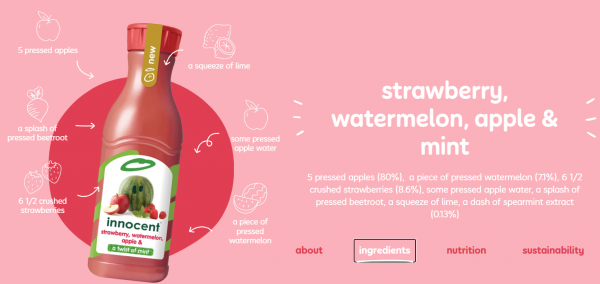
Let’s analyse how customers are easily mislead. The Innocent strawberry, watermelon, apple and mint juice sounds refreshing and delicious, with all natural ingredients and a great combination of fruit. Right? By looking at the front picture of the product, you would think that the most abundant are watermelon or strawberries. A big watermelon catches consumers’ attention and a bunch of strawberries too. But only an apple and a half appears in the photo. However, the back label shows that 80% of the product is made of apples and it only has 9% of strawberries and 7% watermelon. Shocking! By law, packaged foods and beverages must bear an accurate list of their ingredients in descending order of predominance by weight. As apple is listed in third position at the front of the label, customers may expect a product with less apples more strawberries and watermelon.
The following example from the same juice maker repeats the same pattern. The front of the package shows 3 different pieces of fruit, namely blueberry, blackcurrant and cranberry. Logically, consumers would think that these are the only ingredients in the product but the back label indicates that there are 3 more ingredients in this product. Ironically, these 3 additional ingredients represent more than 85% of the total content of the product. Blueberries, blackcurrants and cranberries represent only 13% of the juice.The label is clearly misleading as effectively this is an apple juice with some other added ingredients.

Generally speaking, this practice has spread to other companies. Mockingbird is another example. The name of the product is Raw Shield and the front of the plastic bottle lists the ingredients as follows: mandarin, lemon balm, carrot, ginger, turmeric and ginger. Again, a surprise arrives up when you check the back label of this product. The first and most abundant ingredient is apples. The ingredients listed on the front represent 40% of the total content. Comparing Mockingbird’s Raw Shield with previously mentioned Innocent juices, Mockingbird product seems a bit better but, nevertheless, it is still an apple juice.

This same story repeats over and over. Take and check another Mockingbird juice and, at this point, you will no longer be surprised as all juice companies follow the same modus operandi. Thus, Mockingbird’s Raw Lift juice lists pineapple, spinach, kiwi, celery, kale and cucumber at the front of the container but the back, as always, shows different ingredients. Front of the package listed ingredients make 42% of the juice. So, it means that more than 50% of the content are other ingredients. Apple is the first and most abundant ingredient, although curiously the company does not state the percentage of apples used in the product while percentages are shown for other ingredients.

This is the same with all beverage corporations. They all use apples as the base of the product, because it’s cheap. However, the point is not about cheap or expensive fruit . The main point is that all juice companies mislead consumers, while it seems that there is no a regulation in place to prevent these unethical and unfair practices. Consequently, customers struggle to find healthier choices in an unregulated “ocean of apples juices”.
So, to prevent being fooled by big food corporations, in this case juice companies, avoid fruit juices if you want to prevent development of chronic diseases such diabetes type 2 and obesity. “Eating your juices” will always be healthier because you will also consume fruit fibre.
I picked these fruit juices randomly, personally I don’t have anything against these products and companies, but if you check any other product on the market, you will find exactly the same situation.
