In the 1980s and 1990s, fat was a despised nutrient. Non-fat foods ruled supermarket shelves, promising weight loss and good health simply because of what they didn’t contain. Today, the view of fat is more nuanced. Some fats, the saturated ones and trans fats, can indeed be harmful to health if consumption isn’t limited. But other fats are actually good for optimum health.
The healthiest diets, we now know, are not the ones that are fat-free, but the ones in which the fats are mostly unsaturated rather than saturated. The Mediterranean diet is one example. It is rich in unsaturated fats.
Fatty acids, the building blocks of fat, are classified as saturated, monounsaturated or polyunsaturated. All fats contain a combination of these three types, their properties are determined by the predominant fatty acid. In addition, manufactures can create trans fats by adding hydrogen to liquid fats.
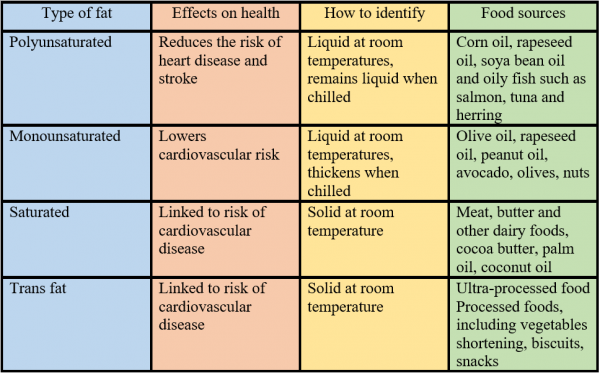
Which fats should you avoid?
Body needs some fat as it is a major source of energy. It also enhances absorption of vitamins and minerals. But you should avoid fats classified as saturated and trans fats as much as you can.
Good fats include monounsaturated and polyunsaturated fats. Bad ones are industrial-made trans fats. Saturated fats fall somewhere in the middle. So, increase your good fats intake and reduce, minimize or totally cut off bad fats to support your health.
